
Sequencing in Golf: Why Your Swing Lacks Power and Consistency


Most golfers think their swing is the problem.
They search for the next tip, try a new drill, or change their tempo on the range.
But sometimes, the real issue is deeper.
They have a sequence problem.

If your body cannot flow in the correct order, your swing will always fight repeatability and consistency no matter how much you practice.
What Is Sequencing in Golf?
Sequencing is the process of transferring energy through the body in the correct order during the downswing.
It starts from the ground, moves through the legs, pelvis and then into the torso, arms, and hands before reaching the club.
When this works properly:
Force builds efficiently
The club path becomes more predictable
Contact trends towards “center & square face” at impact
Ball striking becomes more consistent
The Key to Better Ball Striking
The key to power is transferring force correctly.
When force is transferred efficiently:
Energy flows from the ground up
The body creates speed without extra effort
The club arrives at impact with better alignment
This is what produces:
More distance
Better ball striking
Improved consistency
Without it, every shot becomes a compensation.
Why Golfers Struggle With Consistent Sequence
Many golfers understand what the swing should look like.
They still struggle to produce it.
Why?
Because efficiency is not just a skill—it’s a physical capability.
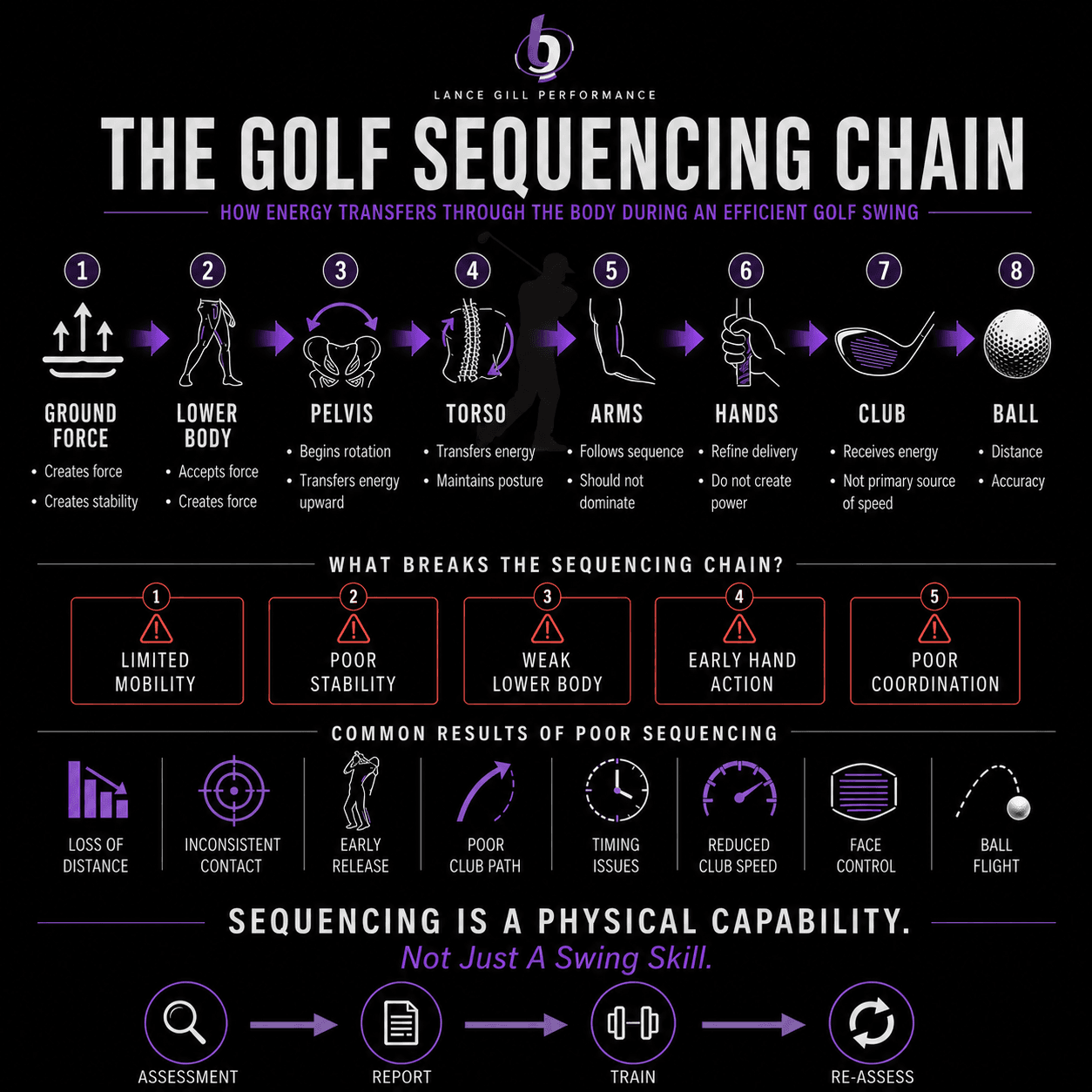
If your body cannot:
Rotate through the hips and Thoracic spine properly
Maintain posture through the back (spine)
Control movement during the downswing
Then your sequence will always break down.
Proper Downswing: How the Body Should Move Correctly
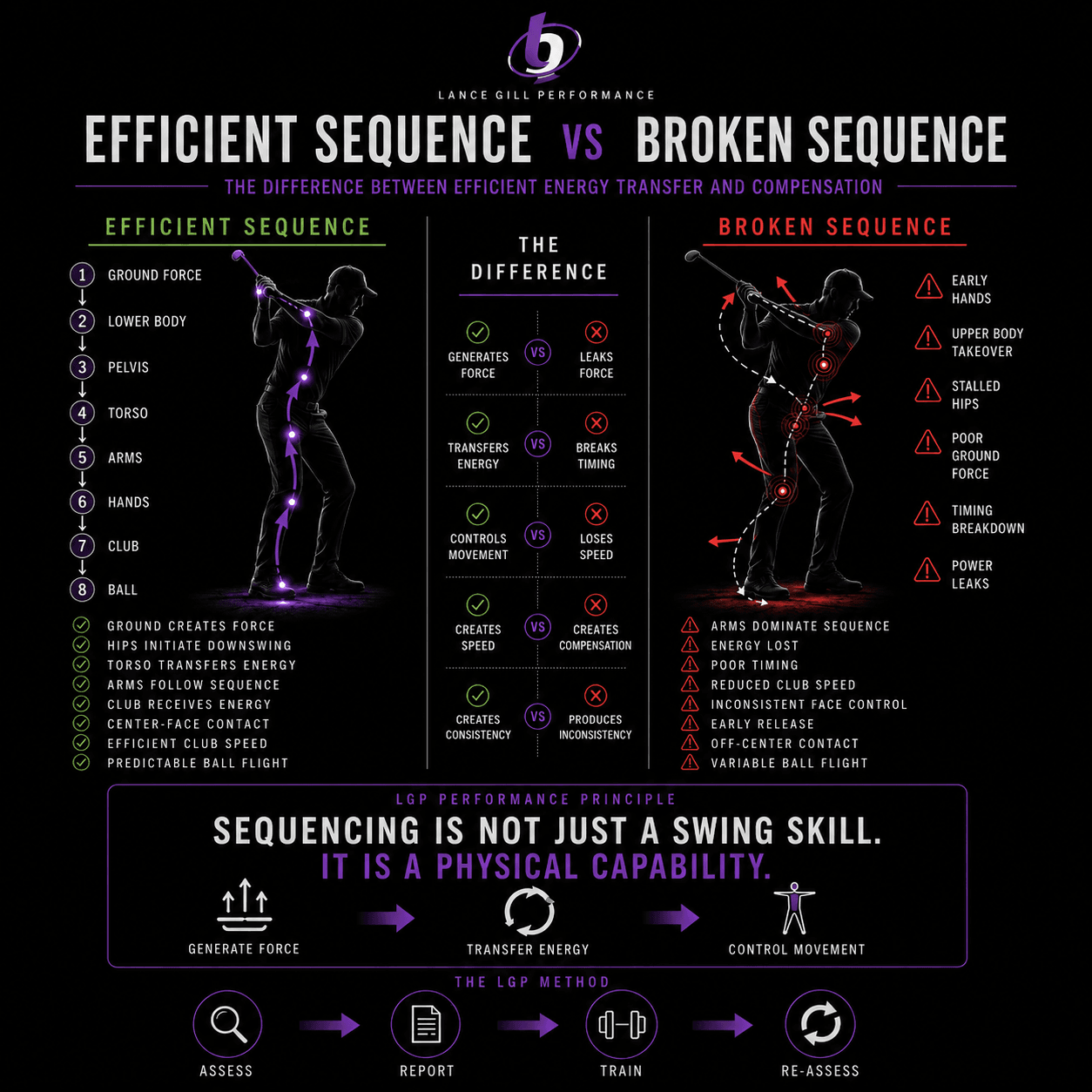
A proper downswing starts from the ground.
The trail leg begins to push into the ground
The hips start to move first
The torso follows
The arms and hands deliver the club
This chain creates efficient power.
Most Golfers develop issues stemming from:
Force development is too late and too low
The hands starts early into downswing
The upper body takes over
Power and energy leak
This leads to:
Poor club path
Weak impact (offcenter and unsquare contact)
Inconsistent ball flight patterns
What Breaks the Timing
Several physical limitations can disrupt timing:
Limited mobility prevents a full turn (pivot)
Poor stability causes early movement or extremely late movement
Weak lower body reduces ground force
Lack of coordination disrupts timing
These issues create:
Early release
Poor shaft and face alignment
Loss of ability to create speed for distance
Inconsistent contact
Power Transfer; Feel the Release for Long and Straight Shots
Your body determines how well you can transfer power.
Not new thoughts.
Not 'one' position.
Not a viral TikTok video.
Lower Body (Ground Force Production)
Your ability to push into the ground drives everything.
Without it:
You cannot generate force efficiently
You lose power
The swing never starts correctly
Torso (Energy Transfer)
The torso is the energy transfer center (transmission) between lower body and arms/club.
If this area lacks proper mobility and stability properties:
The energy transfer becomes inefficient
Timing breaks down
You lose consistency
Arms and Hands (Energy Delivery)
The arms should respond—not lead.
When this fails:
The hands try to correct the problem
The club is delivered inconsistently
Common Problems Golfers Experience During Play
Early or late release in the downswing
Poor hip and torso timing
Loss of ground force
Inconsistent impact position
These are not just swing issues—they are movement problems.
A Simple Drill to Improve Feedback
This drill builds awareness of proper movement.
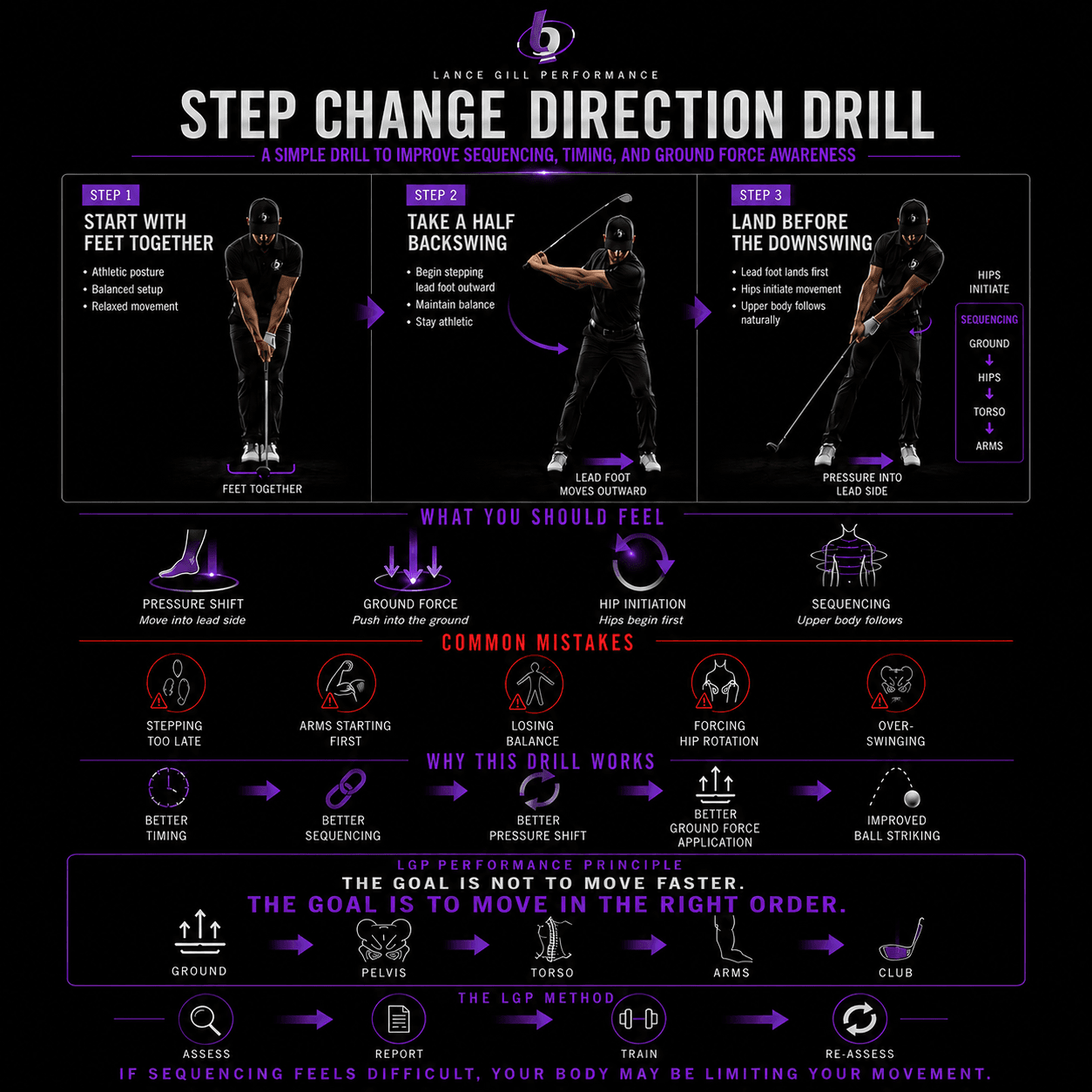
Step Change Direction Drill
- Start in setup position with feet together
- Slowly take a half backswing, while stepping your lead foot to normal stance width.
- Allow the lead foot to hit the ground prior to your downswing beginning.
- Feel the lateral move and hip rotation initiating the downswing.
- Allow the upper body to follow naturally without forcing it.
This helps you:
Feel the correct flow
Improve timing
Improved force application on lead and trail feet.
Develop better movement patterns
How to Fix Your Golf Swing by Improving Sequence
If you want real improvement, focus on the root cause.
Step 1: Identify the Problem
Work with a coach or assessment to find:
Mobility restrictions
Stability issues
Strength limitations
Step 2: Build the Right Physical Qualities
Focus on:
Lower body strength
Rotational mobility
Core stability
Step 3: Apply It on the Range
As your body improves:
Energy transfer becomes more efficient
Your swing becomes more repeatable
Your results become more predictable
The Essential Ingredient to improvement

The secret is...improving how your body:
Generates force
Transfers energy
Controls movement
When your body improves:
Ball striking improves
Club speed increases
Distance and accuracy improve
Is Your Sequencing Broken?
You may have a sequencing issue if:
- You lose distance despite swinging harder
- Contact quality varies day to day
- Your hips feel stalled
- Your arms dominate transition
- Your club speed has plateaued
- Lessons haven't solved consistency
Most golfers assume these are swing problems.
Often they are physical capability problems.
If you are experiencing any of these; we start with a physical assessment to get a full breakdown of your movement patterns and physical limitations.
Train with purpose.
Stop guessing. Start improving.
Team LGP